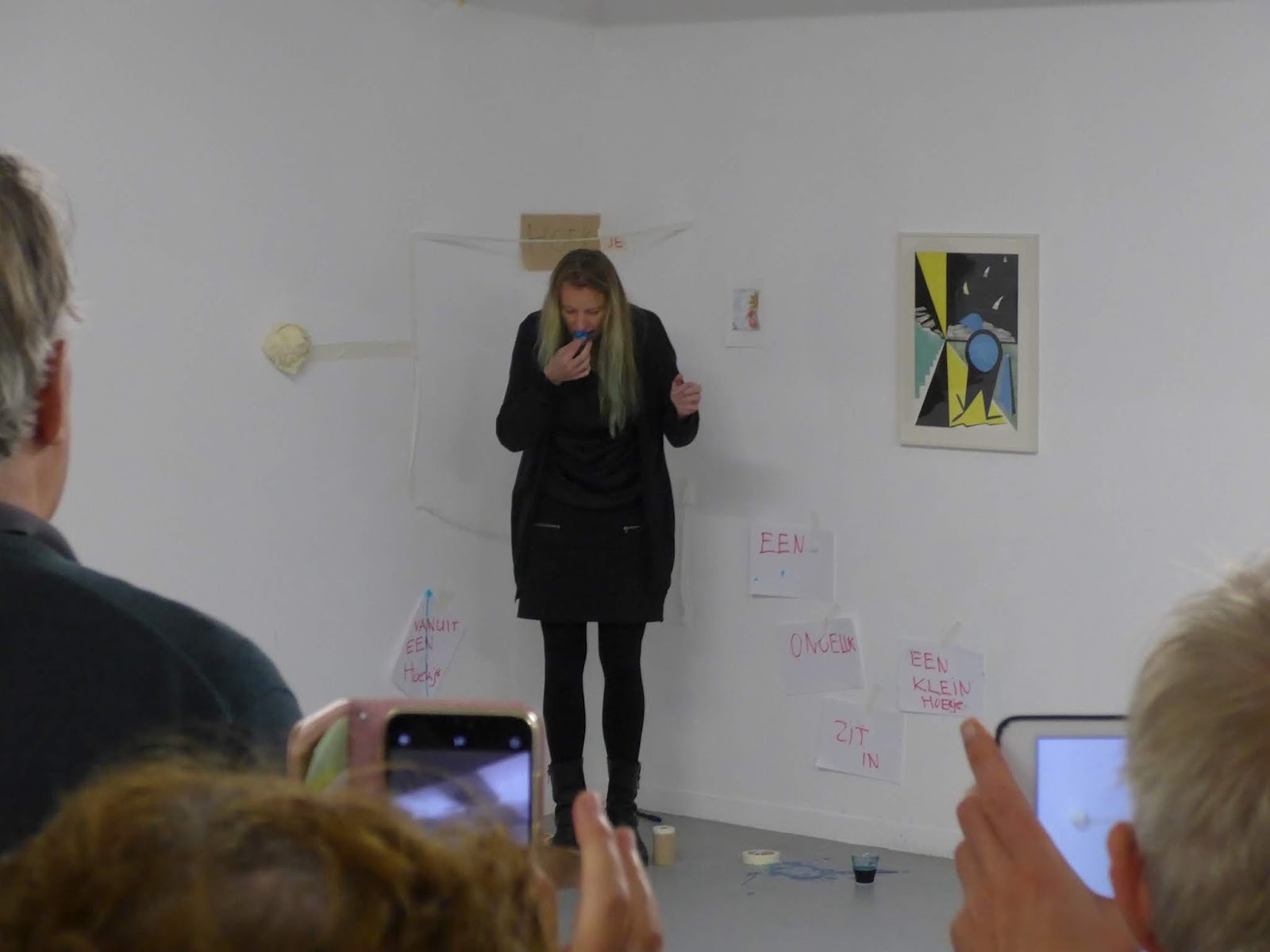
Photography: Kees Koomen, Ellen Rodenberg, Marie Pauw and Dolf Pauw.
One of the projects from: Dolf Pauw last sunday at QUARTAIR The Hague.
LINK MÊKH-web
MÊKH-web / live 13 jaar EX-MÊKH
MÊKH-web Live! will take place this weekend
at QUARTAIR: Toussaintkade 55, 2513 CN, The Hague
Remaining opening times: 5, 6 October 13-17:00
Yesterday the invasion of the invited artists of the last weekend of MÊKH-web began at 1:00 pm.
Featuring: Topp and Dubio, Machiel van Soest, Zaida Oenema, Stijn Peeters, Nies Vooijs, Riet Vooijs, Lucius Pax, Corine Barendregt, Loes Grotenbreg, Roeland Langendoen, Diederik Gerlach, Helène Penninga, Marisa Polin, Leontine Lieffering, Dolf Pauw, Miranda Meijer, Marlies Adriaanse, Laura van Eeden, Alfred Beekenkamp, among others.
Performances will be done sunday afternoon by Jolanda Jansen, Frans van Lent, Charlotte van Winden, Kees Koomen adding to the work of Marian Wijnvoord, Niels Post, Frans van Lent, Ellen Rodenberg, Maarten Schepers and Kees Koomen.
Mêkh-web live! will receive all invited artists for a joined venture. It will be a weekend of exploring art on and of.
Over more than 20 artists are invited to join between the 6 artists who where already in this exhibition.
Today and the day after, all the new artists will be anounced. LINK MÊKH-web
Swedish climate activist Greta Thunberg chastised world leaders Monday, Sep. 23, for failing younger generations by not taking sufficient steps to stop climate change. "You have stolen my childhood and my dreams with your empty words," Thunberg said at the United Nations Climate Action Summit in New York. "You're failing us, but young people are starting to understand your betrayal.
LINK Greta Thunberg's speech to world leaders
@ the Georges Papazov Art Gallery in Yambol
dedicated to the 110th anniversary of the birth of Prof. Panayot Panayotov,
Изложба, посветена на 110 години от рождението на нашия земляк художника проф. Панайот Панайотов, бе открита вчера, 3 септември 2019 г. в Художествена галерия „Жорж Папазов“ в Ямбол. Тя се състои от около 70 непоказвани досега на публиката картини, притежание на синовете му проф. Панайот Панайотов-Пането и Михал Михалев, които също присъстваха на събитието. Почетното участие на галерия „Жорж Папазов“ е само с една творба – автопортрет на художника…
The exhibition, dedicated to the 110th anniversary of the birth of our countryman, the artist Prof. Panayot Panayotov, was opened on September 3 2019 at the Georges Papazov Art Gallery in Yambol. It consists of around 70 paintings that have not been shown to the public so far, owned by his sons Prof. dr. Panayot Panayotov-Paneto and Mihal Mihalev, who also attended the event. With just one work, the honorable participation of Georges Papazov Gallery is a self-portrait of the artist…
De tentoonstelling, gewijd aan de 110e verjaardag van de geboorte van onze landgenoot, de kunstenaar Prof. Panayot Panayotov, werd geopend op 3 september 2019 in de Georges Papazov Art Gallery in Yambol. Het bestaat uit ongeveer 70 schilderijen die tot nu toe niet aan het publiek zijn getoond, eigendom van zijn zonen Prof. Panayot Panayotov-Paneto en Mihal Mihalev, die ook het evenement bijwoonden. De eervolle deelname van Georges Papazov Gallery is met slechts één werk - een zelfportret van de kunstenaar…
Read more: article written by Svetlana Chamova
LINK delnik.net
1965 Carlos Puebla
Grupo los MAMBISES en LA HABANA VIEJA
filmed by carlos garcia 2012
A esto es lo que le temen los gánster del norte los enemigos de la humanidad.... con 60 años de bloqueo malvado, despiadado y todavía siguen con ese espíritu de amor , de alegría, de humildad y sobre todo con un corazón de oro por que esa hermandad que existen entre ellos la trasmiten a aquellos que visitan la isla.
"Hasta Siempre, Comandante", or simply "Hasta Siempre", is a Cuban song from 1965 written by Carlos Puebla. The lyrics are an answer to the farewell letter from the revolutionary Che Guevara when he left Cuba to stir up the revolution in the Congo and later Bolivia. Here he would later be imprisoned and executed.
The lyrics describe some important moments from the Cuban revolution and describe the revolutionary role of Che Guevara as a commander. The song became an icon after the death of Guevara and many cover versions were made, often by left-wing artists. The title refers to a Guevara motto, "¡Hasta la Victoria Siempre!" (Until the victory always).
LINK Grupo los MAMBISES en LA HABANA VIEJA
DPhoto
Het Nederlands Fotomuseum, the national museum of photography in the Netherlands, has re-stored the colour work of photographer Ed van der Elsken from destruction. This summer, the museum celebrates with Lust for Life: the first retrospective of Ed van der Elsken in colour. LINK The national museum of photography Rotterdam
Directed by Karim Dridi (2000)


Miguel Del Morales, the 76-year-old troubadour who strums and sings his way through Karim Dridi's uplifting film ''Cuba Feliz,'' embodies the wandering minstrel as a man of the people and the repository of an impoverished nation's hard-won emotional wisdom. As he travels from one city to another in his native Cuba, meeting up with local musicians and jamming with them, Mr. Del Morales, who is known as El Gallo (the Rooster) suggests a Latin-American Willie Nelson (without his band), indefatigably making his way along his country's dusty roads.
A wiry, weather-beaten figure, El Gallo, clad in a black tank top and sombrero, is first glimpsed smoking a cigarette and gazing over the Havana harbor as a cargo ship slips into port. The song he sings with an impassioned resignation is a lament of the hardship of life, the passing of time and loves lost but not forgotten.
Although ''Cuba Feliz'' has the look and sound of a documentary, it's really a loosely constructed musical road movie with a screenplay (by Pascal Letellier and Mr. Dridi) that follows El Gallo from city to city on a national tour undertaken largely on foot. Toting his guitar, he ambles from Havana to Santiago de Cuba, Guantánamo, Camaguey and Trinidad, ending up back in Havana in the same spot from which he started… LINK youtube Cuba feliz
Reconstruction and montage by dolf pauw
Presenter Henk Terlingen reports about the moon trip of the Apollo 11 from a studio of the NTS in Hilversum. Rudolf Spoor watches from the control room. Many guests are present in the studio.
The launch is closely monitored add the Simon Stevin public observatory in Oudenbosch. A temporary base has been set up for this in a school, where antennas are set up. With this the radio contact with the Apollo-11 is collected. A farmer watches the moon landing on television while milking a cow.
A model simulates the moon landing, where a man blows through a pipe to blow up dust. After the landing there is applaud.
We (The living room was filled with family and neighbors and me), also watched on a Philips black and white TV at home in Dordrecht to this broadcast I was fifteen years old.
LINK Nederlands Instituut voor Beeld en Geluid
Ramayana, Painted in Kamasan Bali - Date around 1915
research Dolf Pauw

The story: This is a key episode in the Ramayana story, one of the most frequently depicted scenes in classical Balinese paintings. Rawana, demonic king of Langka, kidnapped the goddess Sita and kept her in captivity. After the fall of Langka and the death of Rawana, goddess Sita was reunited with her husband, Rama. But after such a long absence, Rama doubts her faithfulness. Distressed by Rama’s suspicion and in order to demonstrate her purity, Sita orders Laksamana, Rama’s brother, to prepare a pyre into which she jumps. However she is protected by Agni, the god of fire, and the fire turns into a lotus.
The scene:
Agni can be seen in the centre of the paintings with Sita at his feet in a lotus floating on a pool of water. Both are enclosed in a golden aureole, which indicates a god. The servant figures, Twalen and Merdah are seated on the ground close to Sita. On the right, at the top of the ramp, from which Sita has jumped, are Trijata, Sita’s companion during her captivity, heavenly priests and monkey spectators. Hanoman, the monkey general, is below the ramp. Rama and Laksamana appear on the left of the tree with several gods above them and monkeys and other animal creatures below. Flowers descend from above, as a manifestation of Sita’s purity and favour with the gods.
LINK Virtual Museum of Balinese Painting
via Aguanile (en vivo)
Origin research: dolf pauw
It is mambo for the trombone and trompet what is Yama mambo at the beginning of this piece and also begins with Guaguancó rumba de cajon de Cuba then it goes to the use of the Afro-language bone Yoruba language the same mentions the phrase Africa conjugates with the blow of trombones and trumpets and it ends with Afro cubism in a orixá of the seas YEMOJA there is also something of the spiritual songs practiced in Cuba as spiritualism which is part of the Afro Cuban traditions called Santeria. LINK: youtube
Photography dolf pauw
Rijksmuseum marks the 350th anniversary of Rembrandt’s death in 2019 with ‘Year of Rembrandt’. The year-long celebration opens with ‘All the Rembrandts’, in which the Rijksmuseum will present for the first time an exhibition of all 22 paintings, 60 drawings and more than 300 best examples of Rembrandt’s prints in its collection. LINK Rijksmuseum Amsterdam